CATEGORIES
|
| |
Insertion Flowmeters |
How Insertion Flowmeters Work
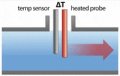
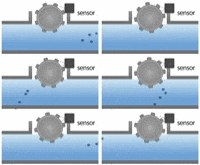
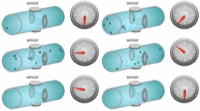
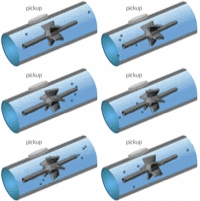
Insertion flowmeters measure flow at one location in a pipe and use this measurement to infer the flow in the entire pipe. Differential pressure, magnetic, target, thermal, turbine, and vortex shedding insertion flowmeters can be used to measure flow at one location. When the velocity profile is distorted, such as after an elbow, using measurements from multiple measurement locations can increase accuracy.
Hydraulic issues associated with an application, such as the measurement location, are similar for the different flow measurement technologies (i.e., differential pressure, magnetic…). For larger pipes, the measurement location is usually representative of the average flow rate. For smaller pipes, the measurement location is usually at the centerline of the pipe, and hydraulic relationships may be used to calculate the average flow rate. Some manufacturers use proprietary measurement locations.
A flow computer may be used to calculate the flow in the entire pipe.
How to Use Insertion Flowmeters
Insertion flowmeters measure the flow of liquids, gases and vapors in pipes, such as water, air, industrial gases, and steam. They are subject to the constraints and limitations. For example, magnetic insertion flowmeters can only measure liquids with sufficient conductivity.
Insertion flowmeters are used in large pipes because their sensor and support structure are usually much less expensive than an equivalent full-bore flowmeter. As a result, the cost of the sensor is about the same whether the pipe is 8 or 80 inches in diameter. In addition, insertion flowmeters obstruct only a small portion of the flow stream, so pressure drop is typically small.
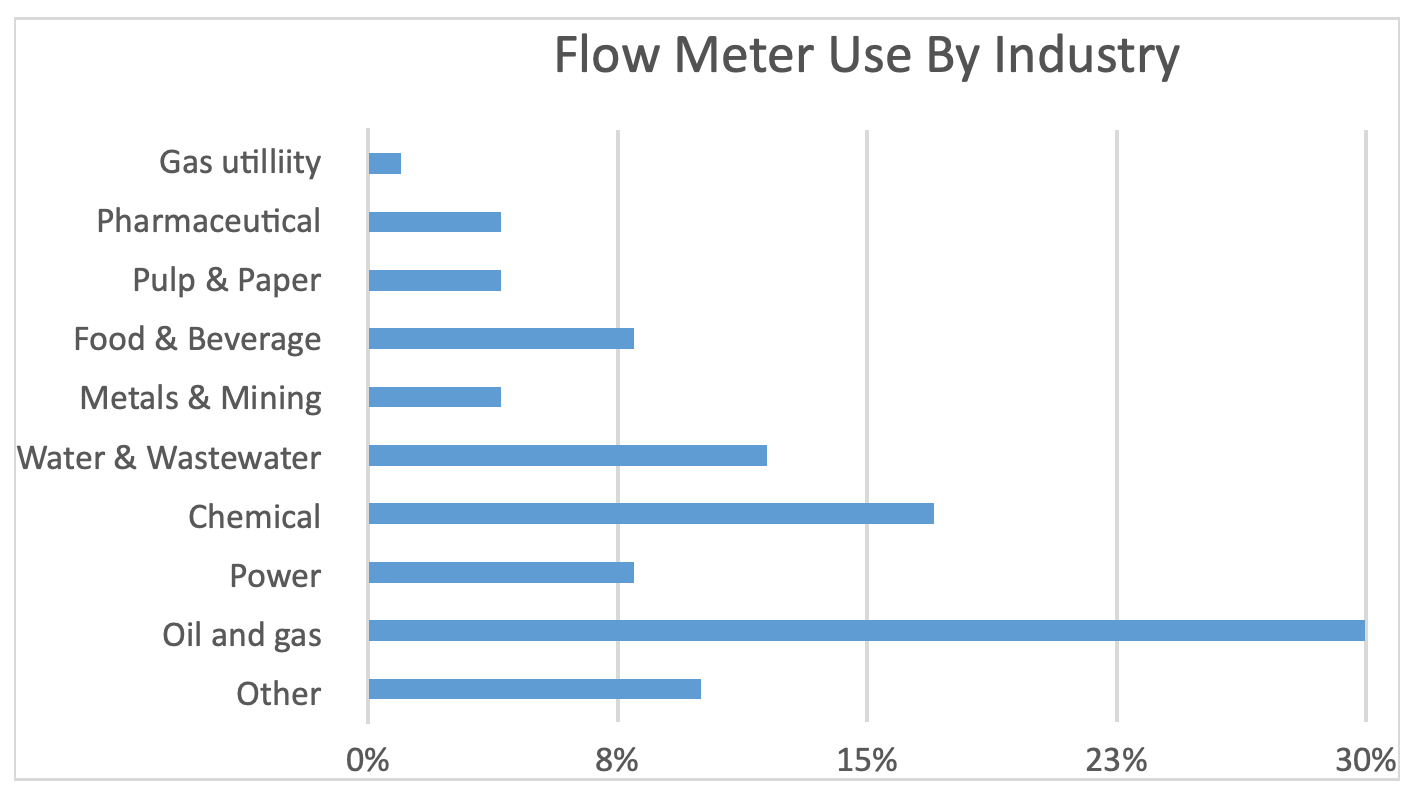
Many applications for insertion flowmeters are found in industries that have larger piping, such as in the mining, mineral processing, pulp and paper, petroleum, chemical, petrochemical, water, and waste water industries. However, insertion flowmeters are also used in smaller piping, such as in industrial water treatment systems and high-purity piping systems often found in the semiconductor and pharmaceutical industries.
Application Cautions for Insertion Flowmeters
Understand that, unlike a full-bore flowmeter, insertion flowmeters do not measure the flow in the entire pipe --- they infer the flow in the entire pipe from a small number of measurements. Hydraulic and other measurement issues can result in large measurement errors.
Be sure that adequate straight piping is installed upstream to condition the flow so that the flow at the point of measurement represents the average, center-line, or proprietary flow that was used for calibration purposes. Locate the sensor properly so as to measure at the correct location, because failure to do so directly affects measurement accuracy. Make provisions to remove the flowmeter, such as installing a valve and sealing arrangement when the pipe cannot be taken out of service.
|

Let me help you find a flowmeter
|
|
|
|